- Joyce Beers
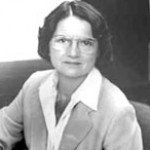
Joyce Beers
Her name appears on our community center in the Uptown District, but who was Joyce Beers? She was an active and community-minded woman who was instrumental in shaping the early organizational elements of the Hillcrest. And she was a proponent of many projects that changed the face of our neighborhood.
Joyce was a champion of public transit and neighborhood revitalization. She loved Hillcrest. For 16 years Joyce served on the San Diego Transit Board and received a special commendation from SANDAG for her work on public transportation.
From Joyce’s husband and daughter… Hillcrest was the first Business Improvement District in all of San Diego. Areas like North Park and Normal Heights have taken their inspiration from our organization and the Hillcrest sign. Speaking of the sign. The first CityFest was a sign relighting celebration (which was basically run out of the Beers family garage). The sign had been a non-functional eyesore for years. Mom thought refurbishing it would be a good rallying point for gathering donations and provide a symbol of the rebirth of a neighborhood. It worked.
This is where I think mom’s real gift was, interpersonal diplomacy. She was able to bring together gay and non-gay business owners, getting them ...
- Kate the Great
One of her favorite sayings: “A 50¢ tree should be planted in a $5 hole.”
Katherine Olivia Sessions (1857-1940) was known to many as “Kate.” During her long career in San Diego (which began as a teacher) she became a world-recognized horticulturist, florist, nurserywomen and landscape designer, Kate imported, introduced, propagated and popularized hundreds of trees, palms, vines, shrubs and succulents. These include many of our most beloved plants: poinsettia, bird of paradise, Italian cypress, twisted juniper, queen palm, yellow oleander, Carolina yellow jasmine, banyan, New Zealand Christmas tree, Aleppo pine, Brazilian pepper tree, blue cypress, bougainvillea and star jasmine.
A fervent advocate of developing “City Park,” as Balboa Park was named until 1910, Kate Sessions became the official “City Gardener” as she began extensive plantings on the scrub brush acreage. Beginning in 1892, under contract with the City of San Diego, she planted more than 100 trees a year in the park and contributed more than 300 trees all over the city. In 1907 Kate was one of the founders of the San Diego Floral Association which was greatly responsible for the beautiful parklands for the wildly successful 1915 Exposition. She advocated many of the developed areas such as Palm Canyon ...
- The Father of Hillcrest
Amid a scattering of homes and handful of businesses to the east, our community started being called “Hillcrest” in 1907 thanks to a 40-year-old entrepreneur. Real estate speculators had identified the scrubland for future urbanization and laid out subdivisions as early as the 1870s, but most of the vicinity still remained a jackrabbit hunting ground when the Sisters of Mercy built a sanitarium on the north side of University at Seventh in 1891.
William Wesley Whitson was born in Iowa. According to his grandson Robert, “WW’s father, John W. Whitson, first came to California as a bindle stiff (he rode the rails),” but his parents moved to the Golden State in 1869 when WW was three. His father operated a small lumber mill in Smith River near the Oregon border, and his uncle founded the town of Selma, just south of Fresno. When he was 20, WW sailed into San Diego Bay to build his future. On February 11, 1898 the Los Angeles Times recorded, “The contract for burial of the indigent dead for the ensuing year was awarded to W.W. Whitson & Company.” He was the first San Diego County coroner and later served as a court reporter and city ...
- Gwladys and her Group
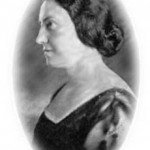
The 1920 census shows Hillcrest resident and doctor Gwladys Morgan, 39, living at 3768 Eighth Street (now called avenue) with her older sister Mabel Elliott, also a physician, Mabel’s teenage son David and the girls’ younger sister Janette. Their large home still stands near the Robinson Street onramp to Highway 163 south. Gwladys was also a poet who in her spare time created children’s literature about Wales. Two years later she led one of San Diego’s most prestigious organizations gaining national “who’s who” status for the group and their officers.
Gwladys was the president of the San Diego Business and Professional Women’s Club in 1922. The group’s 140 members represented nurses, doctors, librarians, bookkeepers, accountants, musicians, stenographers, clerks, buyers, teachers and welfare workers. The club held luncheons on the first and third Wednesdays of each month with dinner parties on every second and fourth Wednesday. When a rare fifth Wednesday occurred the ladies threw an evening soirée. The parties, as well as other functions, gave the members the opportunity for social companionship since the busy women were employed throughout the day. The various programs allowed the women to live vicariously through travel presentations showing the beauties of far-off lands, the thrill ...
- San Diego’s First Female Architect
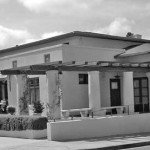
Hazel Wood Waterman (1865-1948) may never have received a license to hang on the wall, but she gets credit for several neighborhood landmarks including the Wednesday Club (Ivy Lane at Sixth). Hazel Wood met Waldo Sprague Waterman (1860-1903) at Berkeley while he was earning a degree in mining. His father Robert was the owner of the Stonewall Mine and wanted W.S. to run it. (Papa moved on to be California governor.)
In 1889, the newlyweds moved to Rancho Cuyamaca, started a family and Hazel acclimated to the remote camp life by painting. The governor died in 1891, and when the gold mine closed two years later, the Waterman family moved to San Diego. After dealing with financial challenges, in 1900 they moved into a granite cottage on the southwest corner of Albatross and Hawthorn designed by Irving Gill.
Gill was impressed with Hazel’s ability to grasp architectural ideas, and suggested a career. When her husband died three years later, she took classes via a correspondence school and honed her skills at home while working for Gill on projects including three houses on Seventh Street (now Avenue) for Alice Lee and Katherine Teats. The single mother earned quite a reputation as a creative ...
- Decades of Activism — Leo Wilson
Park West’s Leo Wilson is a third generation Uptown resident — his family moved to Hillcrest 90 years ago. A 1946 article in the Pacific Coast Record referred to his grandfather who was associated with the US Grant Hotel for 34 years, as both GM and a general partner, as one of “the most successful hotel men in the west.”
Leo’s local roots run deep — his parents met as teens on a Hillcrest streetcar; his four older siblings were born at Mercy Hospital; and although raised in Mission Beach, Leo spent time on Hillcrest streets when it was difficult for young gays just coming out. Recently he’s been facilitating community meetings for the newly formed Hillcrest Town Council.
After becoming an attorney in the ’80s Leo was associated with the prominent law firm of Milch, Wagner and Wolfsheimer. He represented experts retained by Alaska in the Exxon Valdez oil spill case and was involved in drafting and legally defending managed growth initiatives placed on California ballots. He was also actively involved with environmental organizations including the Friends of Los Penasquitos Canyon Preserve, the Conservation Committee of the Sierra Club, San Diego Democratic Club and was one of the founders of the ...
- Women
Hillcrest Women
Thank you, Joyce Beers
“Hillcrest will continue to be an open-minded community. It will include yuppies, it will
include gays and senior citizens…”
Her name appears on our community center in the Uptown District, but who was Joyce Beers? She was an active and community-minded woman who was instrumental in shaping the early organizational elements of the Hillcrest. And she was a proponent of many projects that changed the face of our neighborhood.
Joyce was a champion of public transit and neighborhood revitalization. She loved Hillcrest. For 16 years Joyce served on the San Diego Transit Board and received a special
commendation from SANDAG for her work on public transportation.
The 92103 resident and activist was also the co-founder of the Uptown Community Planning Committee, serving as its chair from 1971 to 1973 then again from 1975 to 1976.
Joyce ran for the District 2 City Council seat in 1979, the year that Bill Cleator was elected. Her many accomplishments include being President of the League of Women Voters from 1973 to 1975 and the first Executive Director of the Hillcrest Association in 1984. Joyce Beers died in 1989 at the age of 60. It’s a proper fit to have our central neighborhood meeting hall named ...
- Mother Mary Michael Cummings
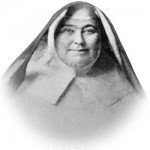
It was a long road from St. Louis to this frontier town, but founding a hospital in San Diego became a mission for this woman of God who first received a white veil and holy habit from the Order of Mercy in 1871. At the call of Denver’s Bishop J.P. Machesion in 1882, Sister M. Michael left Missouri to build schools and hospitals for local mining towns near Durango. After seven years, Bishop Francis Mora of Monterey summoned her to California and confirmed her appointment as Mother Superior. At the request of Father Ubach she and Sister M. Alphonsus came to San Diego in 1889 and founded St. Joseph’s Dispensary the following year.
The dusty town was not welcoming, but they were directed to “build a hospital with their own means.” With determination, courage and $50 from Father Ubach the Sisters of Mercy rented the upper stories of the Grand Central Hotel at the corner of Sixth and H (now Market) and opened the dispensary with five beds. She now forged ahead to plan the first hospital for people of any race, gender, religion, social or financial status. The Sisters were eventually accepted as a community asset, and M. Michael began ...
- A Hillcrest Craftsman Since 1953
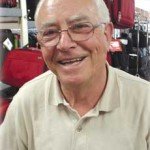
At the age of 74 Hillcrest’s oldest businessman has a contagious smile, nine grandchildren and a remarkable set of bushy eyebrows…yet after 54 years he still repairs luggage in the back of his store. Amazingly, the namesake for John’s Fifth Avenue Luggage also finds time to garden and play the links at Singing Hills Golf Course. John Balistreri is a Hillcrest icon with a strong work ethic and a loyalty to customers and employees that has contributed to his great success.
The Italian native emigrated from Sicily in 1950 and lived/worked downtown before securing a job at Foster Shoe Repair near the corner of Fifth and University. Three years later Mr. Foster sold the business to the young Balistreri who continued to work six days a week in the space now home to Alexis’ Greek Restaurant. Looking for a way to increase revenues and provide a better life for his family, he began selling luggage. He soon realized the profit was much greater (and easier) than spending all day with repairs. John seized the new opportunity and grabbed on with gusto.
He expanded his space next door to 3849 Fifth Avenue (now Flashbacks) and the first John’s Fifth Avenue Luggage came into ...
- Bridging Communities — Aida Mancillas

I began working as an artist in the late 1980’s having received my education in the visual arts at Humboldt State University (BA, 1985) and UC San Diego (MFA, 1988) In 1991 I received an individual artist fellowship from the National Endowment for the Arts for my “works on paper” which constituted one of a kind artists’ books and paintings done on paper. This fellowship allowed me the opportunity to work for a year on my own work, developing themes and a working process that I have carried through today. This process involves layering and mixed media.
From small books and paintings I went on to work on large scale public art; a real change. I also went from a solitary artist to one who works collaboratively and with community groups or agencies. In the public art sphere the artist doesn’t have complete control over the process or sometimes even the outcome; one shares vision and direction with others. That seems to work for me, at least in the beginning. I enjoy the dialogue and building with others.
The Vermont Street Pedestrian Bridge (dedicated 1995) was my first project on a large, public scale. It has had both community support and accolades ...
- Mo’s Main Man — Chris Shaw
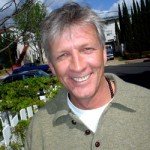
Mo’s Main Man – Chris Shaw
One of Hillcrest’s most successful entrepreneurs is Chris Shaw, but most folks are more familiar with his popular restaurant/bars, Urban Mo’s (formerly Hamburger Mary’s) and Baja Betty’s, than the gentle man himself. The SD native has been involved in the LGBT business community since 1979 when West Coast Production Company (WCPC) opened on Hancock Street west of the I-5. The large warehouse with three jammed bars was “the” place for the gay community to dance the night away.
WCPC’s parking lot was the site for community Pride festivals from 1982 through 1984. The event moved downtown to the County Administration Building’s lot the following year, but when the ’86 festival was cancelled two weeks before the event, Chris again hosted the celebration as volunteers produced the first two-day festival in Pride’s history. The organization honored him as 1988’s Man of the Year and a Champion of Pride in 2006.
The man behind the man is Doug Snyder. Partners for 26 years, the pair has worked quietly to further community organizations for decades. Charitable giving is part of their annual budget. “The community gives so much to us and our businesses. Doug and I feel it’s important to ...
- Transportation in San Diego
Early San Diego Transportation in and around Hillcrest
- University Height’s Normal School
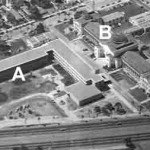
One of Uptown’s great architectural monuments once sat between Normal and Washington streets at Park Boulevard (B on 1955 aerial photo below). San Diego State Normal School, the birthplace of SDSU, was a fine expression of Beaux Arts classicism. While the old school has been demolished to make room for a parking lot, the teacher training building and several other auxiliary buildings remain.
The term “normal school” refers to an institution for the training of teachers, a concept that originated in Europe and gained popularity in the US during the nineteenth century. The term used a secondary definition of the word “normal” referring to a “model” or “pattern” for imitation by students. The location of this school inspired the naming of University Avenue, Normal Heights and University Heights (which originally encompassed Hillcrest).
Hebbard and Gill designed the stately Main Building in 1899. Eleven years later civil engineer Nathan Ellery and architect George Sellon, senior employees for the State of California completed the Teacher’s Training Annex (C). The two-story reinforced concrete building reflects Italian Renaissance Revival architectural detailing. Although the building was not apparently modeled after any one particular precedent, the rectangular plan, symmetrical fenestration and broad overhanging eaves common to this style ...
- Hillcrest’s Design Center
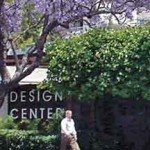
Tree-lined Fifth Avenue at Brookes Street is home to an architectural masterpiece designed by architect Lloyd Ruocco. Born in Maine in 1907, Ruocco moved to San Diego in the early 1920s. A graduate of the University of California at Berkeley, Ruocco is widely credited with pioneering the post-war modern architectural movement in San Diego.
Characteristic of Ruocco’s early designs, the Design Center (1949) is primarily redwood and glass. Its flat roof, floor-to-ceiling glass and decks over the canyon are core design elements of California Modernism. The openness of the design reflects Ruocco’s concern that a building’s relationship with the outdoors should be a harmonious one.
Ruocco’s studio was located at the Design Center, along with the studio and showrooms of his wife, interior designer and professor Ilse Hamann Ruocco. The couple brought artists, designers, photographers and architects to the Design Center shaping the city’s arts community.
In 2002 Blue Sapphire Holdings LLC purchased the building and restored the original fasçade. In 2003, Grace Hollis Lowe Hanson & Schaeffer LLP began using the lower level of the Design Center, while renting the other floors to design professionals. The American Institute for Architecture (AIA) toured the building during its national convention in 2004. The following ...
- A Sweet Treat in Bankers Hill
Just one block west of Spruce Street’s swinging bridge is a grand home designed by Frank Mead and Richard Requa (famed local architects) and once treasured by the A. H. Sweet family. Elaine Sweet, daughter of Adelbert “Del” and Amy Sweet bequeathed her 1914 family home (at 435 W. Spruce) to the San Diego Historical Society in 1985. Ms. Sweet, whose father had been a San Diego County District Attorney, placed several stipulations on its use. The estate would also provide a quarter million dollar endowment fund for future house maintenance.
Above all, Ms. Sweet wanted her home preserved so she outlined her wishes in a trust with suggestions which included a meeting facility for the Historical Society and other community groups, a rental facility for social events, a residence for visiting scholars or possibly a museum. Ms. Sweet also stated that her former residence could not be used as a single family home.
After Ms. Sweet’s death, the historical society tried to honor her request, however any change in the home’s use would have required the consent of the neighbors. After several well-attended meetings, it was made clear that the property owners from the posh neighborhood were vehemently opposed to the ...
- The History of Dartlee Hall
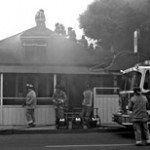
An obscure Hillcrest structure has gained historic integrity after it was recently discovered to be an early work of Irving Gill. Because of the sign that lingers many think of 3680 Sixth Avenue as the burned out Cafe W, although old-timers may recall other eateries, antique stores and religious meeting rooms. But with history dating back to the turn of the century, this may be the oldest surviving commercial building in the area.
In 1899, the ladies of the Wednesday Club purchased this vacant lot near Pennsylvania (then known as Thornton) for $285. The club hired San Diego’s most well known architect to design their plans. Irving Gill created a dark green-shingled cottage bungalow hiding a large Tudor dining hall at a cost of $930. His design was one of the first Arts & Crafts style buildings in town. The open meeting area features a beamed redwood ceiling, huge brick fireplace, leaded-glass windows with dormers on the east and west that function as clearstory windows into the hall, rather than the attic vents one might think from the outside.
The club members loved their home as they planned the downtown library and presented lectures and dramatic performances. Money had not been allowed ...
- San Diego’s Gay Roots — The Brass Rail
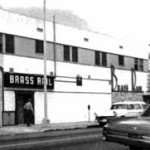
The Brass Rail has gone through many changes throughout the years since patrons had to “put all hands on top of the bar” when vice police would come through with flashlights looking for hanky panky. The bar was originally located downtown at the corner of Sixth and B in the Orpheum Theatre building. It was a restaurant for many years, with a window that looked into part of the kitchen. Old timers will tell you about watching meats roasting on the rotisserie as they lined up for a movie.
When Lou Arko bought the eatery in 1958, it was a popular lunch spot for attorneys, judges and professionals. It also had a lively happy hour with the downtown businessmen and their secretaries met up. The evening crowd changed and more men came in to socialize around the piano bar, then at night the clientele became mostly gay men since this was one of the only place in town where they felt comfortable.
The building was sold for a new high-rise in 1963, and Louie moved to a Hillcrest location at the site of today’s Washington Mutual Bank. The bar was smaller and no longer had a restaurant, but men found a home ...
- Our Beloved Beacon
The Hillcrest sign was first erected in 1940 as a gift to the community from an active association of female shopkeepers wanting to promote the neighborhood business area.
240 feet of pink neon tubing
Weight: 800 pounds
Length: 21 feet
Height: 3.5 feet
First supported by large wooden poles, critics protested the unsightly appearance and soon they were replaced by a steel version. City Councilman Fred Simpson complained the poles made the street appear like a “big tree district.”
After a few decades of use the sign fell into disrepair and darkness. According to the San Diego Union (January 28, 1975) a newly formed Hillcrest Merchants Guild had plans to relight it, but HillQuest couldn’t confirm that ever happened. In 1983 it was taken down and rebuilt after neighborhood fundraising events that solidified the community. On August 26, 1984 at 8pm it was relit once more, and everyone was so proud of Hillcrest and what we had accomplished.
Number One Fifth Avenue owner Carol Arko recalls, “When they pulled the switch to light the sign the crowd just roared. Several thousand people crowded onto Fifth and University avenues and both sidewalks all the way to Fourth. Revelers also filled the area around the center of the intersection ...
- Hillcrest’s American Dream
Tung Ling Wong, better known as “Jimmy” and his wife Annie Up Wong, immigrated to the United Sates in the late 1940s and created a new life for themselves on University Avenue near Fourth.
Soon after their immigration Jimmy gained employment as a waiter at the Chinese Village restaurant in downtown San Diego. Within a few years, the Wong’s invested their savings of $3,000 in a Hillcrest restaurant. It was the right move for the Wongs.
Opened in 1955, Jimmy Wong’s Golden Dragon became the premier Chinese restaurant in town. Jimmy’s talents extended beyond that of a running a restaurant. He designed the registered historic landmark neon dragon on the outside of the building. He also designed and painted the large golden dragon that once spanned the length of the ceiling.
Many generations of neighborhood Hillcrestians and prominent San Diegans have been regular diners at the restaurant rubbing elbows with celebrities including Marilyn Monroe, Gary Cooper, Patricia Neal and Frank Sinatra just to name a few. The wide mix of regulars dined until 3am, 363 days a year, closing only on Thanksgiving and Christmas.
Jimmy and Annie’s son Gary summed it up when he spoke for the 2003 Uptown Historic Oral History Report. “I ...
- Rich Divorcee Kills Herself
Editor’s Note: Mrs. Henrich, burned twice by society marriages, departs the world in melodramatic fashion, leaving her estate to a local contractor. Was it love? What “work” did she want carried on? At which “fashionable,” “brilliantly lighted,” “palatial” Park Boulevard apartment house did she reside? Do you know? The home of banker H.E. Anthony still survives in the 3300 block of Front Street.
— two stories as reported in the Los Angeles Times —
December 1, 1922
Mrs. Helene Henrich found dead in San Diego home
Former husband is ignored in farewell letters
Will bequeaths bulk of her estate to contractor
Dead by her own hand, the body of Helene D. Henrich, wealthy divorcee, was found late last night in the luxurious suite of the fashionable apartment-house she owned and operated. When the police broke down the doors of the brilliantly lighted apartment, they discovered her body, shot through the head and still warm. All theories except that of suicide were eliminated by the fact that Mrs. Henrich had made careful and detailed dispositions of her estate. Calmly preparing herself for death, Mrs. Henrich wrote four letters and left them with her will on a desk. Members of her family were not mentioned in the will, ...